


Best Way To Cook Beans To Avoid Gas and Bloating
Trouble digesting legumes? You my be FODMAP sensitive, or it may be that you haven’t learn the best way to prepare them now for best digestibility. Bonus, they retain they vibrant color, their taste and their crunch! The method: Soaking and steaming!
Many people with digestive issues complain of issues digesting foods containing gluten or/ and dairy or with legumes. Not surprisingly, they complain of bloating.
Fact is, gluten, dairy and legumes have something in common: they are high in sugars. They are what we call “high FODMAP products, i.e. they easily ferment in our digestive tract. Question : Do you have IBS, digestive symptoms, or do you just need to cook your beans better?
Affiliate Disclaimer
This blog contains affiliate links, including Amazon links.
Using this links comes at not cost to you, but financially supports my work in the the making of this website.
As a promise to you, I only promote products I own or would purchase myself, and trust.
Thank you in advance for your support!
Of course legumes are “high protein” compounds, and they contain many essential like folate, vitamins (E) and minerals ( zinc, iron) as well as lutein and zeaxanthin (1) . They are also fiber dense. Both these aspects are positive in themselves. But is that the only factor? Preparation of legumes is as important the fermentation is to lower the amount of gluten in wheat-based foods. People are now widely aware that using sourdough fermentation markedly improves bread digestibility. In the case of legumes also preparation is key. According to a study on the different manners to prepare pulse ( legumes) “Methods to reduce pulse phytate content such as soaking, germination, or sourdough fermentation are thus recommended, especially in vegetarian diets “.
I argue that one of the reasons legumes tend to ferment in our digestive tract is because of the way we prepare them.
Two factors impact legumes’ digestibility: First, soaking dry legumes vs. cooking them directly. Second, how long and what cooking method we use impacts their digestibility and nutrient density. The longer our legumes cook, the more their fibers break down into simple sugars. Sugars tend to ferment in our digestive tract, which causes bloating.
Other popular posts:

Want more recipe like this and health tips in your email box? Become part of the Steamed Cuisine Community!
Key #1: Legumes preparation
Preparation is often an undervalued aspect of health outcomes after eating certain types of foods. Are you weary of processed foods?
Let’s be real: ALL foods are processed.
Cutting is processing. Soaking and washing is, too. Deep frying, grilling, boiling is as well. It is the HEALTHY type of food processing to we need to focus on, and reintroduce in our cooking practice. In the case of legumes, we recommend buying dried beans rather than canned, and soaking them. Soaking is not a huge prep step, and it really improves the nutritional impact of your foods.
Must do: Soaking Dried Grains
Some foods need a specific type of preparation: soaking.
- Soaking wakes the plant, the plant lives, toxic compounds are excreted.
- Soaking is the start of the sprouting (i.e; germination) process: it also starts multiplying nutrients with a goal of growing a new plant !
- Waking the plant makes it easier to digest
- Dried beans are stored in paper bags or food pails. This avoids contamination from plastic linings and metal cans.
Avoid Canned Legumes: A unhealthy Industrial Processing
Canned legumes are more expensive than you think
If you buy a pound of dried legumes, it easily becomes close to two pounds of soaked legumes and twice the volume. For the price of canned legumes, you can easily get them in bulk and organic ! Here is an example as of July 25, 2026:
15 oz of canned garbanzo beans cost around $1, the equivalent of $2 per pound of dried beans. Comparatively, as of today, dried beans cost between $1.59 at Food Lion and $2.49/ lb at Harris teeter ( North Carolina). Besides, you can even improve nutrition by buying ORGANIC garbanzo beans in bulk at $2.08 / lb at Azure Standard which is a comparable price per pound than the non organic canned beans.
2 lbs dried black beans cost $2.99 at Aldi vs. 95c for 15/lb canned. This means that half a pound dried, which are equal to a can of beans cost 75c vs 95c for a can.
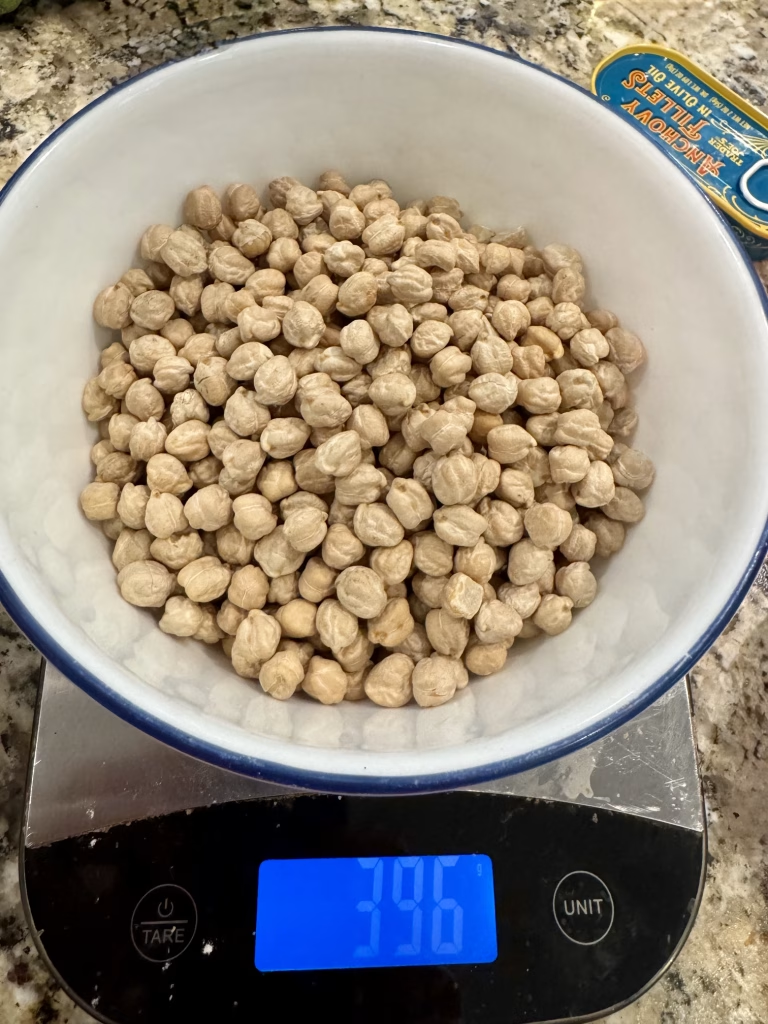
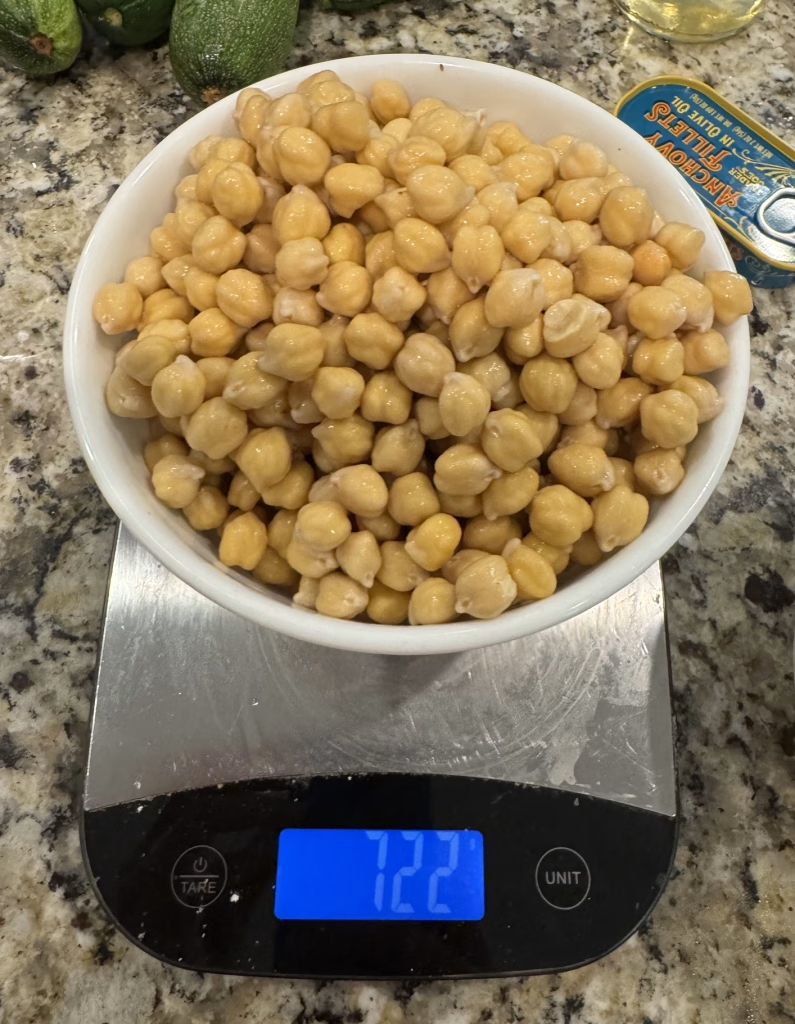
Canned legumes are not soaked before cooking
This Youtube video is pretty instructive. Although the industry claims that they soak dried beans, rather they soak them in hot water (75°C to 85°C which is 157 to 185 °F, i.e. a temperature also hot enough to start cooking them. As well intentioned as the industry is, you have to wonder if this is optimal. Nature does not wake and sprout plants at such high temperature, but rather at 65°F to 85°F ( 18 to 30°C)
Manufacturing is meant to be efficient, which explains that the industry doesn’t give plants the required time to wake!
Oftentimes, industrial legumes are pressured cooked
To obtain a soft food from a rock hard legume very fast, they need to rise the temperature very high.
I won’t go into length about the type of pots that are used in the industry to cook beans. I read that soy beans are often cooked in huge aluminum tanks. Do you avoid aluminum in deodorant? Think about aluminum use to process foods. Needless to say, this process contaminates your beans. After that, they are stored in a metal. Convenient or not, this article is meant to help you rethink if processing beans yourself is as difficult as you think, and if it may not be worth your time after all.
Canned goods are not as nutrient dense
According to the study mentioned above (1) , canned legumes lose protein and fiber content compared to household cooked legumes. The study explains that the household cooking method used is boiling after soaking from 25 to 1:30 minutes. Nowhere near the amount of time I use to cook beans in my food steamer, the Vitalizer.


Key #2: Cooking Method
Most people know that deep frying is probably the worse cooking method you can use for your health outcomes. Grilling at high temperature in the way that burns fats is also damageable to our health, because it burns fats into carcinogenic compounds.
Cooking legumes at home ? AVOID pressure cooking
- Pressure cooking is a high heat prep method, i.e. it does destroy many nutrients naturally present in foods. As a result, you are eating a healthy food deprived of all its most interesting assets: its nutrients!
- Pressured cooked beans are often overcooked. By cooking either too long or at high temperature (above boiling temperature i.e. 220°F to 250°F), fibers are transformed and complex sugars are broken down into simple sugars. This rises the glycemic index of your foods, which are higher in simple sugar. Needless to say, this isn’t positive if you tend to be insulin resistant.
Boiling for too long: bad for digestion?
In the study mentioned above, legumes are boiled after soaking for a significant amount of time”
“After draining the water, pulses were cooked in mineral water (Pyrenea, Auchan, Croix, France) at a ratio of 1:2 (seed:boiling water) for 25 min for lentils, 1 h 30 min for white beans, kidney beans and flageolets, and 2 h for chickpeas. Three independent cooking s of each pulse were performed.”
This is nowhere near the amount of time I cook my legumes in my steam cooker.
Cooking too long:
- Damages more heat sensitive vitamins like vitamin C;
- Destroys more fibers and transforms them into simple sugars, thereby raising their glycemic index;
- Personal preference: by softening fibers more, the legumes are softer, less crunchy. Crunchiness increases the need for chewing, which mobilizes digestive enzymes in our mouth and improves digestibility.
Steam cooking vs other cooking methods
Note that after reviewing studies on steam cooking vs. other cooking methods I found that in many studies, researcher seem to steam vegetables for 5-20 minutes. I usually steam most vegetables from 2 (green leafy ) to 20 minutes ( for a whole big potato or artichokes) so they retain most texture , color and taste. The amount of time you need for steaming depends on the efficacy of your food steamer. To be sure that you didn’t overcook food, you need to look at 4 organo-leptic ( a mix of texture and color) criteria
Nutrition Density Cooking Criteria: Color, Flavor, Texture, and Scent
- COLOR (just how vibrant is the deep or light green, red, orange, etc, color of your vegetable after you cook it?
- FLAVOR ( natural taste is still present, the vegetable hasn’t turned too bitter yet)
- TEXTURE : your vegetable is still crunchy, you still need to chew before you swallow,
- AND SCENT: you can still smell the natural scent of the plant.

Steaming Legumes: The ultimate Health Tip?
You may not believe me yet it is the truth: I find steamed legumes tastiest and easiest to digest.
Here is my method to steam legumes:
- Preparing legumes for steaming is the same method as for boiling them: you will need to soak dried legumes overnight to wake the plant. For black and kidney beans, I typically soak them 24 hours.
- Pour some boiling water in the tank of your food steamer. Then Turn on your food steamer – and in this case I do recommend you own the Vitalizer steam cooker . To find out why, read my article on Best Performing Food Steamers for 2025, Based on Health
- Once the steam is clearly coming out of the steamer, it is ready to use. Rinse your legumes and strain the water. Use a strainer that fits in the food steamer’s basket and place all legumes in. Place the bell-looking lid on top.
Legumes Cooking times:
- Presoaked split orange lentils: steam for 3 minutes ( after that they lose their bright orange color);
- Presoaked French or green lentils : steam for 5 minutes in a strainer placed in the steaming basketand cover with the bell-shaped lid;
- Presoaked split green beans or fava beans : 5 to 10 minutes
- Garbanzo beans: after soaking overnight, place them directly into the steaming basket and cook 5 to 6 minutes. This is the time I use when I make hummus with my beans!
- All other beans ( black beans, northern beans, kidney beans, lima beans: after soaking overnight or for 24 hours, place directly on the basket and cover with the bell-shaped lid and cook 20 minutes, max. They require more cooking because of their size or denser fiber content.
- Fresh beans don’t require soaking. Green beans, snap peas, snow peas require only 5 minutes of steaming for a bright and vibrant green crunchy, flavorful result !
F.A.Q
How often should I strain and rinse?
When I soak my beans 24 hours, I strain and rinse them everty 12 hours.
What if the temperature changes?
In the summer I sometimes also strain and rinse in the middle of the day, to make sure they are damp enough to sprout. In the winter, cold temperature may slow down the soaking. typically 12 hours should do.
What if I forget to use soaking beans?
If you forget to use them after soaking overnight, you can:
- Rinse and strain and let them sprout 24 more hours without problem. Sprouting is good. I sometimes use sprouted lentils raw in my salads after 2 to 4 days, like I would sprouted mung beans or microgreens. It’s yummy, crunchy and very nutritious !
- Don’t let garbanzo beans sprout more than two days. they start getting too moist and rotting. If you smell gets potent, you can discard ( or compost !) If you own dried garbanzo beans too long, they may be too old to sprout and plant, but they are still good to soak for 24 hours.
- Steam them and once they have cooled down, refrigerate. They will keep for 3-4 more days without problem. I sometimes refrigerate and use them to make a meal the next day , or hummus.
My soaked beans smell and are sticky. What do I do?
It does happen when you soak garbanzo beans too long, some foamy white compounds also separates from them and stay on the surface of the water. Rinse thoroughly, touch the beans to make sure they no longer are sticky after rinsing. If they remain sticky and the smell is too potent, discard!
Learn more about the impact of your cooking method
- Why is steam cooking the best cooking method? The example with cooking broccoli
- Bloating problems and the cooking method you use
- How to chose a food steamer based on health-centered criteria
- How to chose a food steamer for baby food – pros and cons.
- The Vitalizer food steamer and all its advantages


